Multi-AI Pre-Market Analysis Framework | Better Decisions Beyond Single Indicators

- Published on
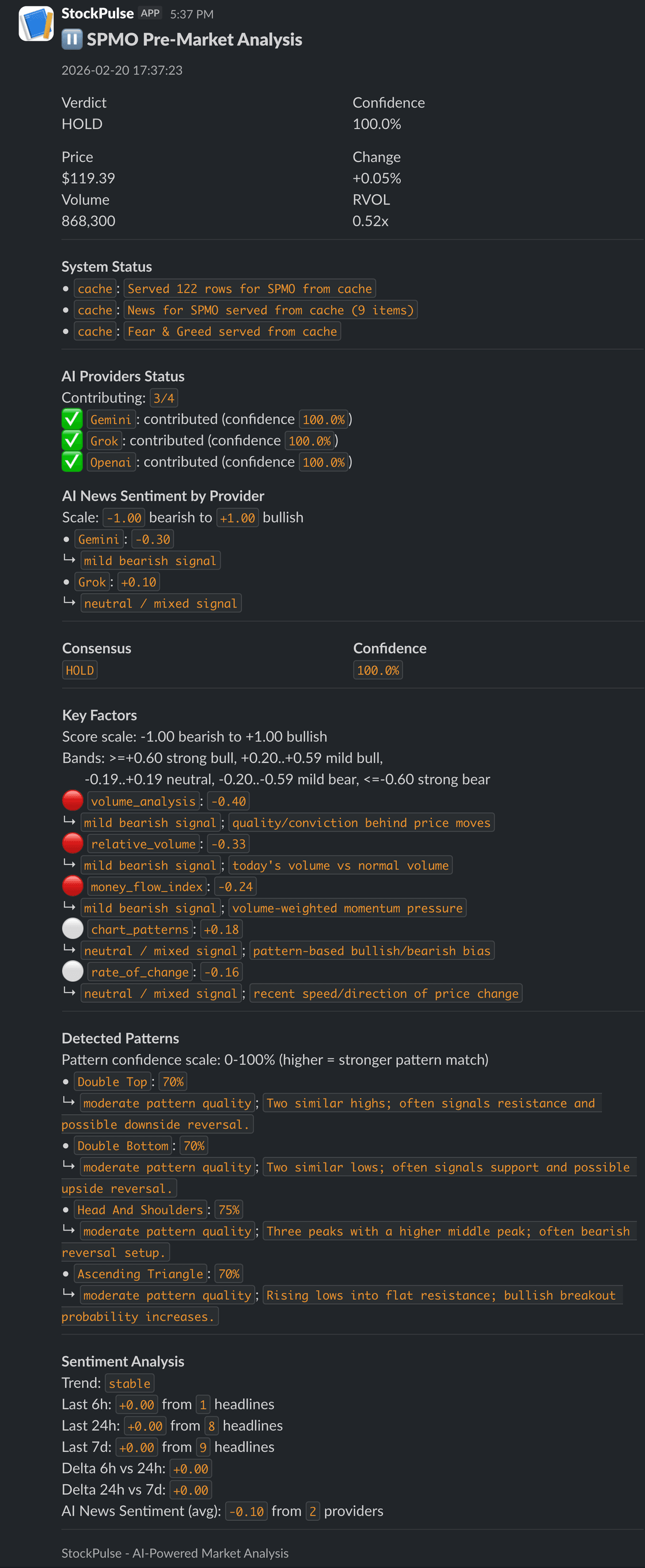
Financial markets are noisy, adaptive, and frequently contradictory. A stock can show bullish momentum while sentiment weakens, or print strong relative volume while pattern quality suggests possible exhaustion.
The problem is rarely "one bad indicator." The bigger issue is overweighting one lens and mistaking partial evidence for conviction.
This guide shows how to build and interpret a practical framework that combines:
- market structure and technical factors,
- pattern detection quality,
- news sentiment trajectory,
- and consensus across multiple AI analysts.
The goal is not perfect prediction. The goal is higher decision quality under uncertainty.
Why Single-Signal Analysis Breaks in Real Markets
Most avoidable trading errors come from one of these failures:
- Regime mismatch: trend tools applied in chop, mean-reversion tools applied in breakouts.
- Context loss: static signal values without volume, volatility, and sentiment context.
- False certainty: confidence presented as probability instead of cross-signal agreement.
A production-grade pre-market workflow should answer three questions before execution:
- What is the current directional bias?
- How strong and internally consistent is that bias?
- What could invalidate the thesis quickly?
Architecture Overview: Inputs to Decision-Ready Output
Input Layer
The framework ingests five evidence streams:
OHLCV and relative participation
- Price structure (open/high/low/close)
- Volume and RVOL behavior
Technical indicator families
- Trend, momentum, volatility, participation, and structure metrics
Pattern detection
- Reversal/continuation structures plus confidence quality scores
News sentiment windows
- Rolling windows (e.g., 6h, 24h, 7d) and deltas between windows
Independent AI analyst outputs
- Multiple providers generate structured verdicts, confidence, and factor-level reasoning
Output Layer
A useful pre-market report should publish:
- verdict (
BUY/HOLD/SELLfamily), - confidence (agreement strength, not certainty),
- live market snapshot (price, change, volume, RVOL),
- provider status and contribution coverage,
- consensus view plus top factors by impact,
- pattern findings with confidence interpretation,
- sentiment trend and recent delta behavior.
Why Multi-Modal Evidence Improves Decision Quality
1) Signal diversification
You diversify information sources the same way you diversify a portfolio. If one signal family fails in a regime, others still provide structure.
2) Better regime handling
Trend-heavy sessions and mean-reverting sessions reward different tools. A blended system is less brittle.
3) Lower narrative overfitting
When technical, participation, and sentiment evidence align, your thesis is usually more stable than narrative-only calls.
4) Explainability and auditability
Factor-level outputs and provider contribution logs make the decision path inspectable and repeatable.
5) Operational resilience
If one AI provider fails or returns malformed output, the system still produces a bounded decision using surviving providers.
How to Read Confidence Correctly
Confidence is often misunderstood. In this framework, confidence means:
- agreement strength across independent analytic lenses, not
- a guaranteed probability of price movement.
Interpretation rule of thumb:
- High confidence + weak participation: be selective; move may be fragile.
- Moderate confidence + broad factor alignment: often better than headline confidence alone.
- Low confidence + model disagreement: preserve optionality, reduce size, or wait.
Pattern Detection: Useful, But Never Standalone
Pattern modules are helpful for timing and invalidation planning, but pattern confidence is a quality score, not a direct return probability.
Use patterns as one vote in a committee:
- combine them with trend and volume evidence,
- prioritize setups with cross-family agreement,
- de-emphasize isolated pattern signals in noisy tape.
Sentiment: Focus on Direction of Change, Not Just Absolute Tone
Static sentiment scores are easy to overread. Trajectory is usually more informative:
- stable negativity vs rapidly worsening negativity,
- neutral baseline vs fresh positive inflection,
- short-horizon spikes vs persistent 7-day drift.
For pre-market decisions, delta behavior (how sentiment is changing) often matters more than absolute sentiment at one timestamp.
Multi-AI Consensus: Committee Intelligence in Practice
A robust consensus layer should:
- collect structured outputs from multiple models/providers,
- reject invalid, incomplete, or malformed responses,
- log provider-level errors transparently,
- aggregate verdict direction, confidence, and factor coherence.
This creates three practical advantages:
- reduced single-model bias,
- more graceful degradation under provider failure,
- explicit visibility into disagreement (which is signal, not noise).
Governance and Risk Controls for Production Use
To make this reliable in live workflows, include:
- data freshness checks and cache integrity validation,
- strict structured-output schema validation,
- explicit distinction between "missing data" and "neutral signal",
- clear provider contribution accounting,
- pre-trade invalidation rules and max-risk sizing policies.
Use this framework as a decision support layer, not autopilot execution.
Practical Pre-Market Workflow
Before the open:
- Pull latest market and participation data.
- Compute technical families and detect patterns.
- Score sentiment windows and deltas.
- Request structured analysis from multiple AI providers.
- Filter invalid provider outputs and log system health.
- Build consensus and confidence from valid contributors.
- Publish one report with factor-level explainability.
This sequence reduces impulsive, single-signal decisions and improves consistency across trading days.
Real Input and Output Example (SPMO)
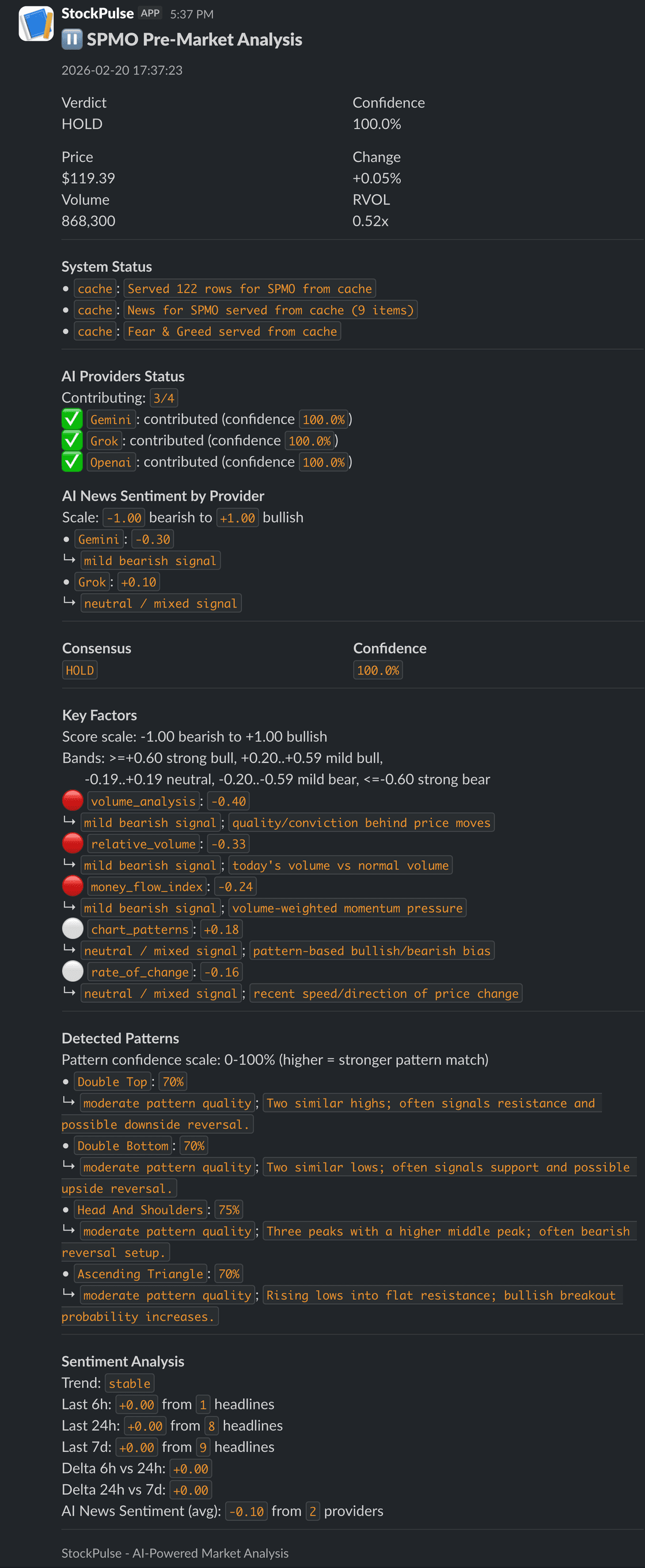
Below is a real dashboard-style output from the framework where inputs (price/volume data, indicators, patterns, and sentiment) are transformed into a single auditable brief.
Input context included:
- OHLCV + RVOL snapshot,
- factor scores (trend, volume, momentum, structure),
- detected patterns with confidence bands,
- multi-window sentiment from headlines and AI providers.
Output produced:
- consensus verdict and confidence,
- key bullish/bearish factors with weighted scores,
- provider contribution and system-status diagnostics,
- actionable interpretation for pre-market planning.
FAQ
Is this framework a trading bot?
No. It is a decision-support framework designed to improve analysis quality, transparency, and consistency before execution.
Does high confidence mean high probability of profit?
No. Confidence reflects evidence alignment across inputs and providers. It does not remove event risk, gap risk, or liquidity risk.
Why use multiple AI providers instead of one model?
Different providers fail differently. Multi-provider consensus reduces single-model bias and improves resilience when one provider degrades.
What is the most common misuse?
Treating one strong signal as a full thesis and skipping invalidation planning. The framework works best when used with explicit risk controls.
Final Takeaway
If you already use technical analysis, this framework does not replace your process. It upgrades it by forcing multiple independent checks before conviction.
Better pre-market decisions come from structured disagreement, transparent evidence, and disciplined interpretation - not from louder single signals.